You check your fasting sugar in the morning.
The value looks fine.
You check your HbA1c every few months.
That also appears reasonably controlled.
But what happens to your glucose after breakfast?
What happens at 3 PM after lunch?
Does your sugar rise sharply after dinner?
Does it fall dangerously while you are sleeping?
Traditional glucose tests give useful information, but they capture individual moments in time.
Continuous Glucose Monitoring, or CGM, provides a much broader view of glucose patterns throughout the day and night.
And in 2026, CGM has become one of the most important developments shaping modern diabetes management.
What Is a CGM?
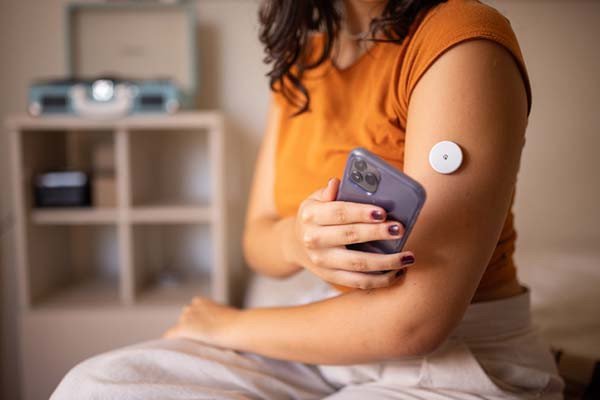
A continuous glucose monitor uses a small sensor placed under the skin to estimate glucose levels in the fluid surrounding the body’s cells.
The sensor collects readings repeatedly throughout the day and can transmit information to a compatible reader, smartphone or other device.
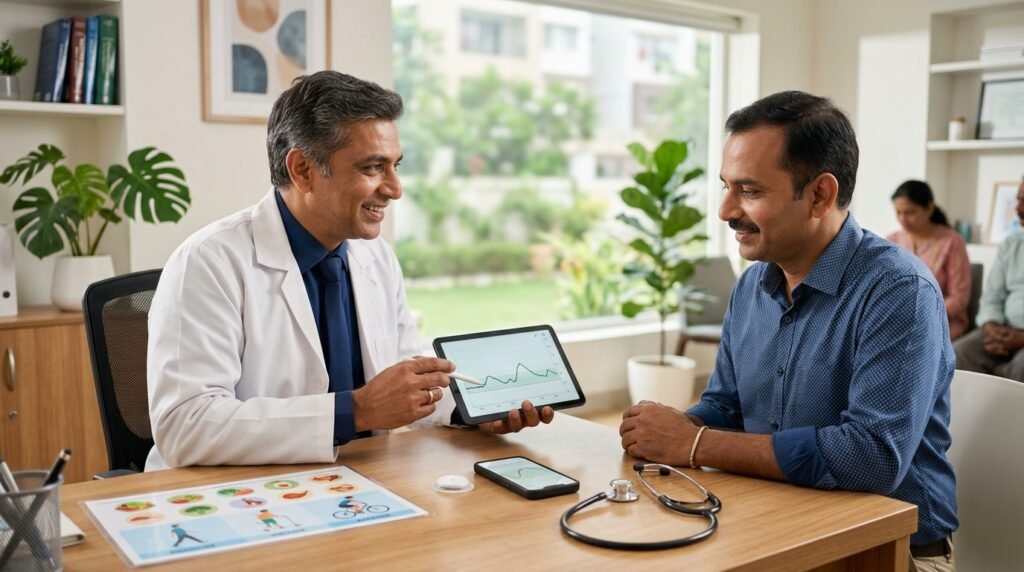
Instead of seeing only one number, patients and doctors can observe patterns.
For example:
Glucose at 8 AM: 105 mg/dL.
After breakfast: rises rapidly.
Before lunch: returns closer to target.
After dinner: rises substantially and remains high for several hours.
That pattern tells a much richer story than the fasting value alone.
NIDDK describes CGM as technology that automatically estimates glucose throughout the day and night.
Why Is CGM Becoming More Important?
Diabetes management is moving from occasional glucose readings toward understanding glucose patterns.
The American Diabetes Association’s 2026 Standards expanded recommendations around CGM, including use among people on insulin, therapies that may cause hypoglycemia and other situations where CGM information can help improve management.
Evidence is also growing for CGM use in some people with type 2 diabetes who are not using insulin.
That does not mean every person with diabetes needs to wear a sensor continuously.
It means CGM has become an increasingly valuable tool when used for the right patient and purpose.
CGM Shows More Than Your Average Sugar
HbA1c remains a very useful test because it reflects average glucose over approximately two to three months.
But averages have limitations.
Imagine two patients with the same HbA1c.
Patient A has fairly stable glucose levels.
Patient B repeatedly swings between very high and very low glucose values.
Their average may look similar, but their daily glucose experiences are very different.
CGM can provide additional information on glucose fluctuations and how long glucose remains within, above or below target ranges.
What Is “Time in Range”?
One of the valuable concepts associated with CGM is Time in Range.
Rather than focusing only on an average, it considers how much of the day glucose is within an individualized target range.
Depending on the patient’s age, diabetes type, pregnancy status, medical conditions and risk of hypoglycemia, targets may differ.
This is why CGM reports should ideally be interpreted together with a diabetes care team rather than judged from isolated numbers on an app.
CGM Can Show How Your Food Affects You
One of the most powerful aspects of continuous glucose monitoring is feedback.
A person may believe their breakfast is healthy because it contains no table sugar.
CGM may reveal that the meal still produces a substantial glucose rise.
Another meal may cause a much smaller rise.
The lesson should not be:
“This food is bad forever.”
Instead, the data can help examine:
Portion size.
Carbohydrate quantity.
Protein.
Fibre.
Meal combinations.
Timing.
Physical activity.
This can make nutrition advice more individualized.
What About Exercise?
CGM can also help patients understand how activity influences glucose.
A walk after a meal may produce a noticeable difference in post-meal glucose for some people.
More strenuous exercise can affect glucose differently depending on medication, insulin use, intensity and timing.
This feedback can help patients see that physical activity is not simply a generic recommendation written on a prescription.
It can have measurable metabolic effects.
Can CGM Detect Low Blood Sugar?
Many CGM systems can alert users when glucose is dropping or has crossed predefined thresholds.
This can be particularly useful for individuals at risk of hypoglycemia.
NIDDK notes that CGMs can provide warnings when glucose falls below a target range.
For people with reduced awareness of hypoglycemia, this feature can be especially valuable under appropriate medical supervision.
Does CGM Completely Replace Finger-Prick Tests?
Not necessarily.
CGM technology has advanced significantly, but patients may still need conventional glucose testing in certain situations, depending on the device, symptoms and treatment plan.
For example, if how you feel does not match the sensor value, confirmation may be necessary.
Patients should follow the specific instructions provided for the CGM device they use.
Who May Benefit From CGM?
CGM may be considered for various groups, including selected people with:
Type 1 diabetes.
Type 2 diabetes using insulin.
Frequent hypoglycemia.
Significant glucose fluctuations.
Difficulty understanding why HbA1c remains high.
A need for more detailed information while adjusting therapy.
The suitability, frequency and duration of CGM use should be individualized.
Some patients may use it continuously, while others may benefit from shorter periods of professional or intermittent CGM to better understand glucose patterns.
Too Much Data Can Also Be Confusing
CGM provides hundreds of data points.
That can be useful, but it can also make patients anxious.
Trying to achieve a perfectly flat glucose line after every meal is unrealistic.
Likewise, repeatedly checking the app every few minutes can cause unnecessary worry.
The objective is not to chase individual numbers.
The objective is to identify patterns and use those patterns to make better treatment decisions.
CGM and Diabetes Care at M.V. Hospital for Diabetes
At M.V. Hospital for Diabetes, Chennai, diabetes management can involve combining traditional investigations such as HbA1c with modern glucose-monitoring approaches when clinically appropriate.
CGM information can help patients and their care teams better understand food responses, medication effects, exercise, overnight glucose trends and episodes of low or high blood sugar.
Diabetes treatment is increasingly becoming more personalized.
Instead of asking only:
“What is my sugar today?”
CGM allows us to ask a more useful question:
“What is my glucose doing throughout my day, and what can I learn from it?”
That shift from isolated numbers to meaningful patterns could play an increasingly important role in the future of diabetes management.